
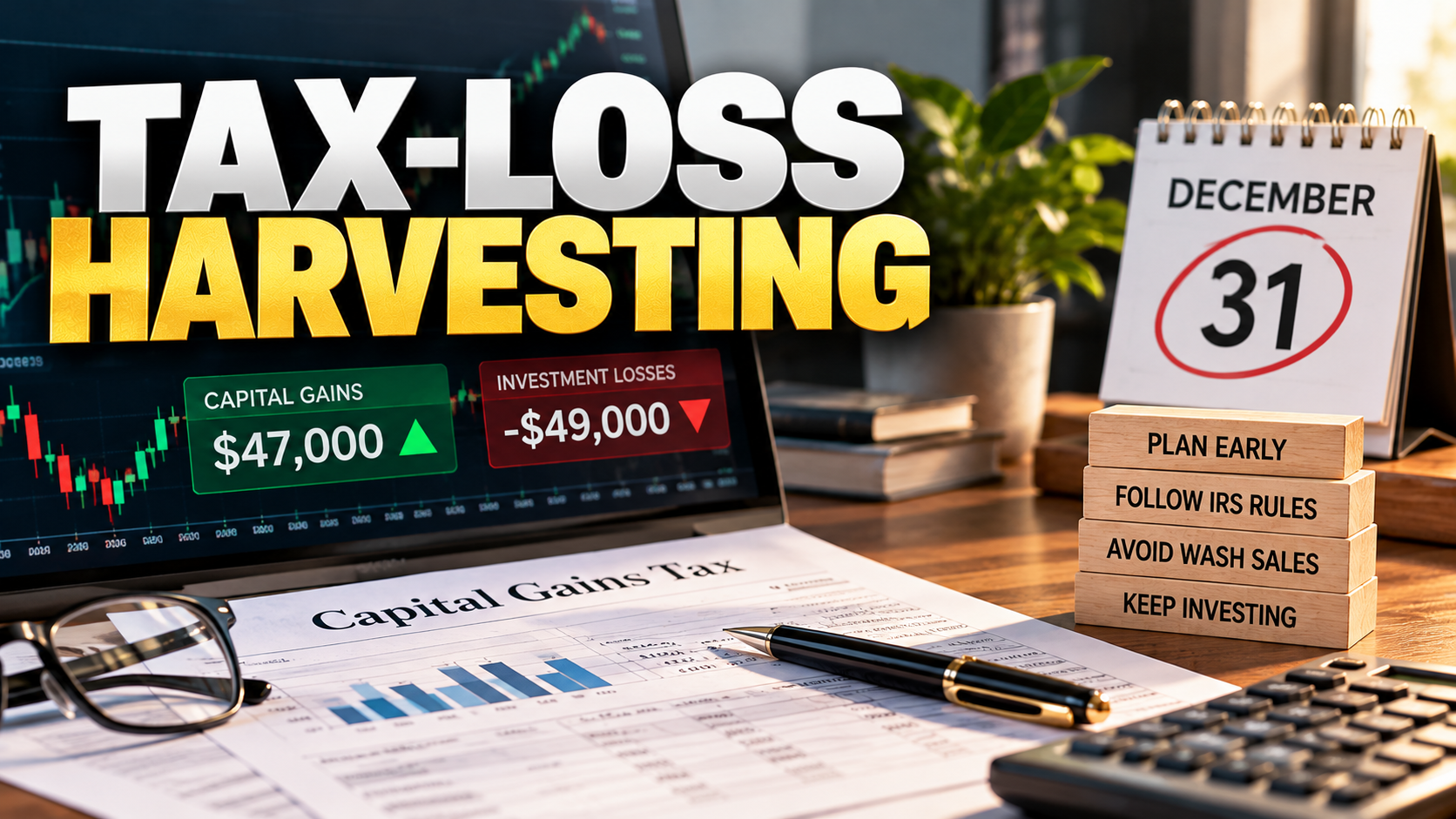
Have you sold stocks or other investments at a profit this year? If so, you may already be thinking about the capital gains tax you could owe. But before the year ends, there may still be opportunities to review your investment portfolio and make informed tax-planning decisions.
Many investors assume that once they sell an investment for a profit, there is nothing they can do until they file their tax return. That is not necessarily true. If you also own investments that have declined in value, tax-loss harvesting may help you offset some or all of your realized capital gains, depending on your circumstances.
The key is understanding how the strategy works, which IRS rules apply, and why timing matters. With thoughtful planning, you can make better decisions about your taxable investments before the calendar runs out.
What Is Tax-Loss Harvesting?
Tax-loss harvesting is an investment tax strategy in which you sell an investment that has declined in value to realize a capital loss. That realized loss can then be used to offset eligible capital gains under the applicable tax rules.
The distinction between an unrealized loss and a realized loss is important. If an investment is worth less than you paid for it but you still own it, the decline generally remains an unrealized loss. Selling the investment is what typically realizes the loss for tax purposes.
For example, suppose you purchased shares for $30,000 and their value subsequently declined to $20,000. If you sell those shares for $20,000, you generally realize a $10,000 capital loss, subject to the applicable tax rules.
If you also realized capital gains from other investments during the year, that loss may help offset those gains. The result depends on your complete tax situation, including the types of gains and losses involved.
Tax-loss harvesting is not about creating artificial losses or making investment decisions solely to reduce taxes. It involves recognizing genuine investment losses while considering how those transactions fit into your broader financial plan.
How Tax-Loss Harvesting Works: A $47,000 Example
Consider Lilly, a consulting business owner in Texas who had a successful year. She sold company stock and part of an index fund to help finance a business expansion. Those sales generated $47,000 in capital gains, including both short-term and long-term gains.
When Lilly reviewed her brokerage account, she discovered two investments that had declined in value. One technology fund was down $28,000, while a small-cap fund had declined by $21,000. Together, those positions represented $49,000 in potential losses.
However, because Lilly had not sold those investments, the losses had not yet been realized for tax purposes.
After reviewing her situation, Lilly sold both losing positions and realized $49,000 in capital losses. Assuming the transactions qualified and the applicable netting rules produced the expected result, those losses could offset her $47,000 in capital gains, leaving a net capital loss of $2,000.
For many individual taxpayers, a remaining net capital loss may be deductible against ordinary income up to $3,000 per year, or $1,500 for married individuals filing separately, subject to the applicable rules. Any remaining eligible loss generally carries forward to future tax years.
This example illustrates the potential value of tax-loss harvesting. However, actual tax savings depend on the taxpayer’s tax rates, the character of the gains and losses, other tax provisions, and whether the transactions comply with IRS requirements.
Why Timing Matters for Year-End Tax Planning
Tax-loss harvesting requires planning before the tax year closes. Waiting until the last few days of December can leave little time to review investment purchases, select the appropriate shares to sell, and avoid unintended wash sales.
October and November can be useful months to review realized gains, identify investments with unrealized losses, and discuss possible transactions with your tax professional.
For example, if you have already sold investments at a profit, reviewing your remaining portfolio may reveal opportunities to realize eligible losses before year-end. You can then evaluate whether selling those investments makes sense from both a tax and an investment perspective.
Timing is especially important because the wash sale rule considers purchases made during a period extending 30 days before and 30 days after a loss sale. A purchase made shortly before you sell an investment at a loss can therefore affect the tax treatment of that loss.
Planning early gives you more time to identify potential problems, review automatic dividend reinvestments, and document your decisions properly.
Understanding the IRS Wash Sale Rule
The wash sale rule is one of the most important considerations when implementing tax-loss harvesting.
Generally, if you sell stock or securities at a loss and acquire substantially identical stock or securities within 30 days before or after the sale, the loss may be disallowed under the wash sale rules. The relevant period spans 61 calendar days when the sale date is included.
For example, suppose you sell an investment at a loss on November 10. You generally need to examine purchases of substantially identical securities from October 11 through December 10, inclusive.
If you purchase a substantially identical security within that window, the wash sale rule may apply. In many ordinary taxable-account situations, the disallowed loss is added to the basis of the replacement investment, potentially postponing the tax benefit. Special circumstances, including certain IRA or Roth IRA purchases, can result in a permanently lost deduction.
Automatic dividend reinvestment can also create an unintended purchase during the restricted period. This is why reviewing your brokerage settings and transactions is an important part of the planning process.
The wash sale rule is more complicated than simply waiting 30 days after selling. Investors should review purchases before and after the sale, including relevant transactions across accounts and potentially those of a spouse.
Can You Stay Invested While Harvesting Tax Losses?
One concern investors often have is that selling an investment at a loss means sitting in cash for a month and potentially missing a market recovery.
That is not necessarily the only option.
Depending on the circumstances, an investor may consider purchasing a different investment that provides broadly similar market exposure without being substantially identical to the security sold. This can help maintain an investment strategy while reducing the risk of triggering the wash sale rule.
For example, an investor selling a fund that tracks one index might consider another fund with meaningfully different holdings or a different investment mandate. However, changing the fund provider alone does not guarantee that the replacement investment is not substantially identical.
The IRS does not provide a universal list covering every pair of similar securities. The determination depends on the facts and circumstances, so investors should be cautious when choosing replacement investments.
The objective is to make a sound investment decision while respecting the tax rules, not to assume that two similar funds are automatically treated differently.
Why Specific-Lot Identification Can Increase Tax-Loss Harvesting Opportunities
Another important detail is how your brokerage account identifies the investments being sold.
You may have purchased shares of the same fund several times over the years at different prices. These purchases are commonly referred to as tax lots. Because each lot can have a different cost basis, selling different lots may produce different capital gains or losses.
Consider an investor who purchased the same technology fund on three separate occasions. Some shares may have a relatively high cost basis, while others may have a lower cost basis.
If the investor sells shares using a default cost-basis method without reviewing the available options, the transaction may realize a smaller loss than an alternative selection of eligible lots.
Specific-lot identification allows an investor to identify the particular shares being sold, following the broker’s procedures and the applicable rules. When appropriate, selecting lots with a higher cost basis may realize larger losses or reduce realized gains.
This decision needs to be made correctly and on time. Do not assume that a selection can always be changed after the transaction settles.
Before selling investments for tax-loss harvesting, review your brokerage account’s cost-basis settings and discuss the available options with your tax professional.
How Short-Term and Long-Term Capital Gains Affect the Strategy
Not all capital gains receive the same tax treatment. Short-term capital gains generally arise from investments held for one year or less and are typically taxed at ordinary income tax rates. Long-term capital gains generally arise from investments held for more than one year and may qualify for preferential federal tax rates.
Capital losses must be netted according to the applicable tax rules. Short-term losses generally offset short-term gains first, while long-term losses generally offset long-term gains first. Remaining amounts are then netted under the prescribed rules.
This matters because the tax impact of realizing a loss can depend on the type of gain it offsets.
In Lilly’s example, $30,000 of her gains were short-term and $17,000 were long-term. Reviewing the holding periods and cost basis of her investments helped her understand how different realized losses could affect the overall calculation.
Investors should not assume they can freely direct a particular loss toward whichever gain has the highest tax rate. The tax rules determine the netting process, while the investor’s choice of which eligible investment lots to sell can influence the resulting mix of gains and losses.
A tax professional can help model different scenarios before transactions are completed.
What Happens When Your Capital Losses Exceed Your Gains?
Sometimes, your realized capital losses may exceed your realized capital gains for the year. When this happens, you may have a net capital loss.
For many individual taxpayers, up to $3,000 of net capital loss can generally be deducted against ordinary income each year, with a $1,500 limit for married individuals filing separately. Special rules and limitations may apply.
If the eligible net loss exceeds the amount you can deduct in the current year, the unused amount generally carries forward to future years, subject to the applicable rules.
For example, if you realize $50,000 in eligible capital losses and have no capital gains, you may be able to deduct a portion against ordinary income in the current year. The remaining eligible loss may be carried forward to offset future capital gains or qualify for a deduction against ordinary income in subsequent years.
This means that a capital loss is not necessarily wasted just because you cannot use the entire amount immediately.
The important thing is to report the transactions correctly and maintain the records needed to support your loss carryforward.
Does Tax-Loss Harvesting Apply to Stocks, ETFs, and Cryptocurrency?
Tax-loss harvesting can apply to investments held in taxable accounts, including stocks, exchange-traded funds, and certain other capital assets. It may also be relevant when an investor has realized taxable capital gains from other investments.
Cryptocurrency requires additional care. Depending on the circumstances, cryptocurrency held as a capital asset may generate capital gains or losses when sold or otherwise disposed of. However, the wash sale rules that apply to stocks and securities do not automatically apply to ordinary cryptocurrency in the same way under current federal tax law.
The tax treatment depends on the asset, the transaction, and the applicable rules. Investors should not assume that every digital asset receives identical treatment.
Accurate cost-basis records are especially important when cryptocurrency transactions occur across multiple exchanges or wallets. Transaction histories may need to be reconciled to determine proceeds, basis, and the resulting gain or loss.
Retirement accounts are another important distinction. Losses on investments held inside an IRA or qualified retirement plan generally cannot be deducted as personal capital losses.
Before harvesting losses, identify which investments are held in taxable accounts and confirm how the relevant transactions should be reported.
Common Tax-Loss Harvesting Mistakes to Avoid
One common mistake is waiting until the final days of December to review a portfolio. Although some securities transactions completed near year-end may count for that tax year under the applicable rules, leaving planning until the last minute increases the risk of overlooking an important detail.
Another mistake is forgetting about automatic dividend reinvestment. A small purchase of a substantially identical security during the wash sale period can affect the tax treatment of a larger loss transaction.
Investors may also overlook purchases in other accounts, including IRAs and Roth IRAs, or fail to consider transactions involving a spouse. These situations can complicate the application of the wash sale rules and may affect whether a loss is deductible.
Using a default cost-basis method without reviewing the available tax lots is another potential source of missed planning opportunities. The lot selected for a sale can affect the realized gain or loss, so it is worth understanding your brokerage’s procedures before trading.
Finally, avoid making investment decisions solely to produce a tax deduction. Selling an investment changes your portfolio, and the potential tax benefit should be weighed against investment objectives, transaction costs, and the risks associated with any replacement investment.
How to Prepare for Tax-Loss Harvesting Before Year-End
Start by reviewing the capital gains you have already realized during the year. Your brokerage statements and transaction records can help you identify the sales that may create a tax liability.
Next, examine your taxable investment accounts for holdings that have declined in value. Consider their cost basis, holding periods, unrealized losses, and role in your broader investment strategy.
Before making a sale, review your brokerage’s cost-basis settings and determine whether specific-lot identification is available. Check recent and planned purchases of substantially identical securities, including automatic reinvestments and relevant transactions in other accounts.
Then discuss the proposed transactions with your CPA or tax advisor. They can help evaluate the expected netting of short-term and long-term gains and losses, estimate the potential tax impact, and identify reporting or wash sale issues.
Keep copies of trade confirmations, cost-basis records, relevant brokerage elections, and information supporting your replacement investment decisions. Accurate records make it easier to prepare your return and substantiate your tax treatment if questions arise later.
The goal is to make informed decisions while you still have time to act, rather than trying to reconstruct the strategy after the tax year has closed.
Final Thoughts: Plan Ahead to Make the Most of Your Investments
Tax-loss harvesting can be a useful part of year-end tax planning for investors and business owners who have realized capital gains and hold investments that have declined in value.
By understanding the difference between unrealized and realized losses, following the wash sale rules, reviewing specific tax lots, and keeping accurate records, you can make more informed decisions about your taxable portfolio.
However, no strategy guarantees a particular tax saving. The result depends on your investments, income, holding periods, applicable tax rates, and the rules governing your transactions.
If you have sold investments at a profit this year, now is a good time to review your portfolio and discuss possible tax-loss harvesting opportunities with a qualified professional.