A healthy business bank balance in December is certainly something to celebrate. But before you start collecting outstanding invoices, transferring money to your personal account, or accepting deposits for next year’s projects, consider how those decisions could affect your tax bill. For S corporation owners, the final few weeks of the year can present valuable tax planning opportunities.
Some of the most effective year-end S Corp tax strategies do not require additional spending, complicated investments, or major changes to your business structure. Instead, they involve making deliberate decisions about when you receive income, pay eligible expenses, process reimbursements, and compensate yourself as a business owner.
For businesses operating on a cash basis, the timing of these transactions can significantly influence taxable income. Understanding what you can legitimately control before December 31 could help reduce your current-year tax liability while positioning your business for a financially stronger 2027.
What Are the Best Year-End S Corp Tax Strategies for 2026?
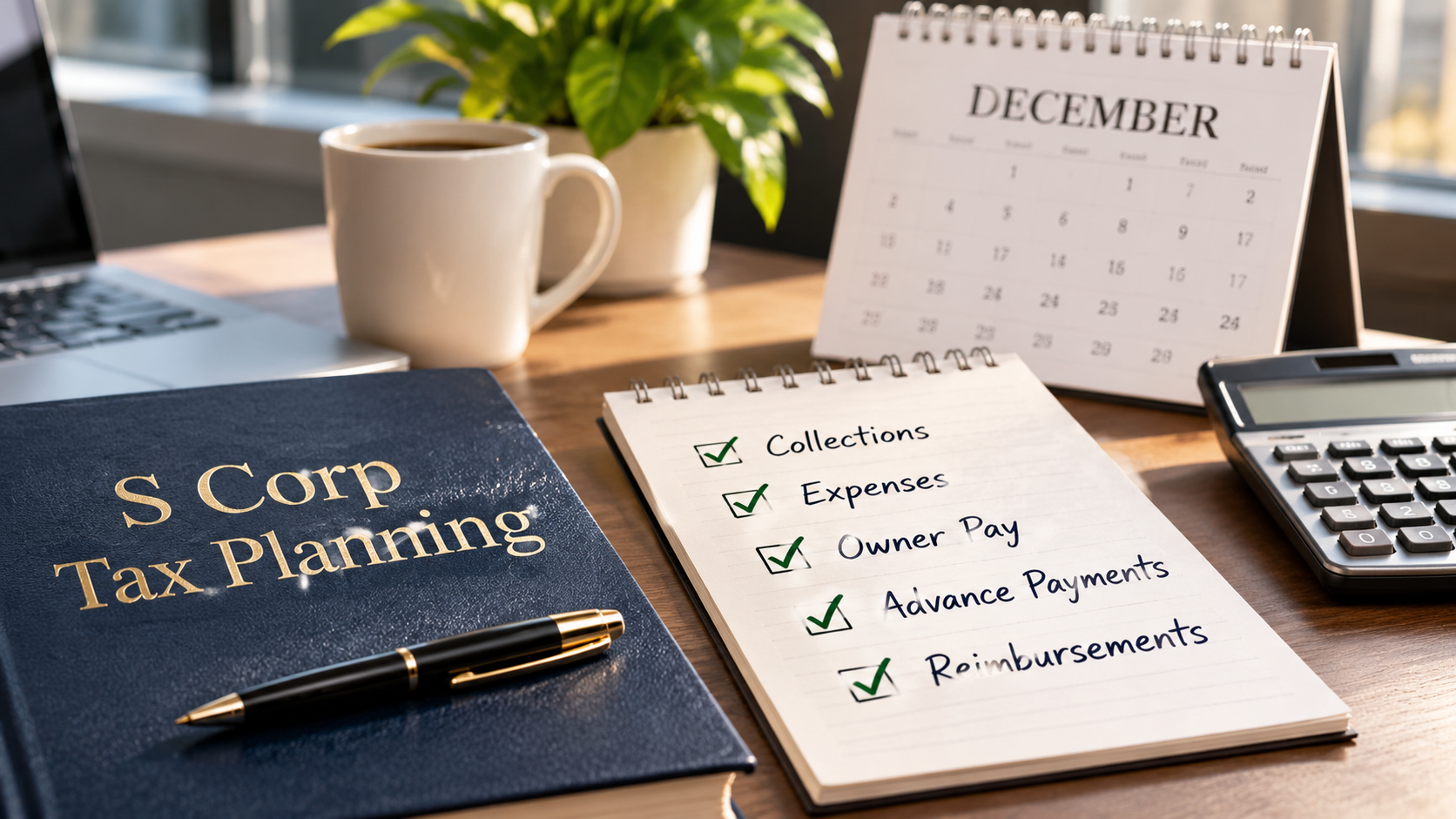
Five effective year-end tax strategies for cash-basis S corporation owners include reviewing the timing of outstanding invoice collections, accelerating eligible business expenses, evaluating reasonable owner compensation, managing customer advance payments, and completing qualified accountable plan reimbursements before December 31.
The effectiveness of each strategy depends on your accounting method, taxable income, cash flow requirements, business structure, and projected financial performance for the following year.
The objective is not simply to pay less tax this December. It is to make decisions that produce a better financial outcome across multiple tax years.
How Cash-Basis Accounting Affects Your S Corp Taxes
Under the cash method of accounting, businesses generally recognize revenue when income is actually or constructively received and deduct qualifying expenses when they are paid, subject to applicable tax rules.
This distinction creates legitimate planning opportunities for businesses approaching the end of their tax year.
However, there is an important limitation. If a customer gives you a check in December, waiting until January to deposit it generally does not move that income into the following tax year. The IRS constructive receipt rules can require income to be recognized when it becomes available to you without substantial restrictions.
That is why effective year-end tax planning needs to take place before payments are received or made available, rather than after the money has changed hands.
Business owners should also remember that the cash method and accrual method follow different recognition rules. Before implementing any timing strategy, confirm which accounting method your S corporation uses.
A Practical Example: How an S Corp Could Reduce Its Current-Year Tax Bill by $20,100
Consider Clark and Maria, who operate a successful home services business structured as an S corporation.
Their business generates approximately $620,000 in annual revenue and $210,000 in profit before owner compensation. With a strong year behind them, several outstanding invoices, upcoming operating expenses, and customer deposits scheduled around the holidays, they have important financial decisions to make before December ends.
For this educational example, assume a combined federal and state marginal tax effect of 30%.
By reviewing three qualifying financial transactions and adjusting their timing, Clark and Maria could reduce their estimated current-year tax liability by $20,100.
This does not mean that all $20,100 represents permanent tax savings. Some of the benefit comes from moving taxable income into the following year. Their actual results would depend on applicable tax rates, state taxes, the qualified business income deduction, and their financial situation in 2027.
Here is how the five strategies work.
1. Review Outstanding Invoices Before Accelerating December Collections
Many business owners want to finish December with as few outstanding invoices as possible. Collecting every available payment can make the business look financially healthy heading into the new year.
However, for a cash-basis S corporation that has already experienced a profitable year, accelerating collections may increase current-year taxable income.
Clark and Maria have two outstanding customer balances totaling $42,000. Both customers are reliable, and the business has enough cash from other collections to cover payroll and operating expenses.
Rather than requesting early payment in December, Clark and Maria review the original payment terms and determine whether the customers can appropriately pay in early January.
Assuming the payments have not already been received or made available to the business, recognizing the $42,000 in January instead of December could reduce the current year’s taxable income by that amount.
At the assumed 30% tax effect, this represents an estimated current-year tax reduction of $12,600.
The business still earns the same revenue and performs the same work. What changes is the tax year in which that income is recognized.
Should S Corp Owners Always Defer Income Until January?
Not necessarily. If your business has experienced a slower year or you expect significantly higher profits next year, collecting income in December could be more beneficial.
The right decision depends on your current tax bracket, projected future earnings, working capital requirements, and the likelihood of collecting outstanding balances.
Delaying a payment should never put payroll, business operations, or customer relationships at risk. Any deferred income should also be included in your following year’s estimated tax planning.
2. Pay Eligible Business Expenses Before December 31
While reviewing incoming payments is important, reviewing outgoing payments can be equally valuable.
For cash-basis businesses, paying eligible deductible expenses before year-end may allow those costs to be recognized in the current tax year.
Maria has approximately $18,000 in legitimate vendor bills, software renewals, and materials invoices that are due in early January. Her usual approach is to hold onto cash for as long as possible, particularly during the holiday season.
However, after reviewing the business’s financial position, Clark and Maria determine that they have enough cash available to pay these qualifying expenses in December.
They are not purchasing unnecessary equipment, creating additional expenses, or spending money simply to obtain a deduction. They are paying existing obligations slightly earlier than originally planned.
At the assumed 30% tax effect, accelerating $18,000 in eligible business expenses into December could reduce their estimated current-year tax liability by $5,400.
Which Business Expenses Should You Pay Before Year-End?
Start by reviewing outstanding vendor invoices, eligible operating costs, professional service fees, software expenses, and other ordinary business obligations.
Not every payment qualifies for an immediate tax deduction. Certain prepaid expenses, inventory purchases, capital expenditures, and other transactions may be subject to different accounting and tax treatment.
Before accelerating payments, ask your CPA to determine which expenses qualify for a current-year deduction and whether paying them early makes sense for your overall financial position.
Spending a dollar simply to save a fraction of that dollar in taxes is not necessarily a good financial decision. The most effective approach involves expenses your business already needs to pay.
3. Understand the Difference Between S Corp Salary and Distributions
One of the most common misunderstandings among S corporation owners is believing that transferring money from a business bank account to a personal account automatically reduces taxable business profit.
It does not.
S corporations generally pass their taxable income through to shareholders, whether that income is distributed or retained in the business.
Clark notices that the business account has a healthy balance and considers transferring $25,000 to his personal account before the holidays. He assumes that because the money is leaving the business, it will reduce the company’s taxable income.
However, an ordinary shareholder distribution is not a deductible business expense.
The transfer would reduce the company’s cash balance without reducing its taxable business profit. Depending on shareholder stock basis and other circumstances, a distribution may also have separate tax consequences.
Should S Corp Owners Increase Their Salary Before Year-End?
S corporation shareholder-employees who perform services for their business must receive reasonable compensation for those services.
A properly processed salary is generally a deductible expense for the corporation, but it also creates taxable wage income for the shareholder-employee. Payroll taxes and other considerations may affect the overall outcome.
An additional salary payment or year-end bonus is therefore not automatically a tax-saving strategy.
For Clark and Maria, the appropriate approach is to review their compensation with their tax adviser, confirm that payroll has been handled correctly, and retain sufficient cash for upcoming tax obligations.
Rather than making an unnecessary transfer based on the company’s December bank balance, they make compensation and distribution decisions based on the company’s actual financial needs.
4. Carefully Manage Customer Advance Payments for Next Year’s Work
Customer deposits are a normal part of many service-based businesses. They help secure projects, cover material costs, and provide working capital before work begins.
However, advance payments received in December for work scheduled in January can create an unexpected year-end tax consequence.
Clark and Maria have two customers who want to secure projects for the upcoming year. One proposes a $12,000 advance payment in December, while another proposes a $9,000 payment before the end of the month.
Together, these advances would bring an additional $21,000 into the business before December 31.
For a cash-basis business, advance payments that represent business income are generally recognized when received, even if the work will not be performed until the following year. Truly refundable security deposits may receive different treatment depending on the agreement and circumstances.
If Clark and Maria accept both advances in December, they could increase current-year taxable income without having completed the associated projects.
Because the business does not immediately need these deposits to purchase materials or cover project expenses, they discuss the payment schedule with their customers before any money becomes available.
They agree on early January payments and document the project start dates and payment terms.
This allows them to coordinate the timing of project income with the financial needs of the business.
Should You Delay Customer Deposits Until Next Year?
The decision depends on your working capital requirements, contractual obligations, and expected tax position.
If an advance payment is necessary to purchase materials or secure labor, accepting it in December may be the right business decision. The priority should be maintaining healthy cash flow and meeting customer commitments.
When payment timing is flexible, however, reviewing advance payments with your tax adviser before accepting them can help you make a more informed decision.
The $21,000 in proposed customer advances is a separate planning example and is not included in the $20,100 estimated tax reduction discussed in this article.
5. Complete Accountable Plan Reimbursements Before Year-End
Business owners frequently pay legitimate business expenses using personal funds. Travel, mileage, office supplies, and qualifying home office costs are common examples.
However, when an S corporation owner pays these expenses personally and never properly submits them for reimbursement, the business may miss valuable deduction opportunities.
An accountable plan provides a structured way for an S corporation to reimburse its shareholder-employees for eligible business expenses.
When implemented correctly, qualifying reimbursements can generally be deducted by the corporation without being treated as taxable wages for the employee receiving them.
To qualify, the expenses must have a legitimate business purpose, be adequately documented within a reasonable period, and comply with the requirement to return any excess reimbursement within a reasonable period.
Clark and Maria already have a written accountable plan in place. After reviewing their records, they identify approximately $7,000 in eligible expenses that were personally paid but had not yet been reimbursed.
These expenses include qualifying travel costs, documented business mileage, and eligible home office expenses.
They gather the necessary receipts and mileage records, confirm that the expenses satisfy their accountable plan requirements, and complete the reimbursements before year-end.
At the assumed 30% tax effect, the $7,000 in qualifying reimbursements could reduce their estimated current-year tax liability by $2,100.
The business is not creating new expenses. It is properly documenting and reimbursing costs that have already been incurred.
If your S corporation has an accountable plan, review outstanding reimbursement requests before December 31. Make sure expenses have not already been deducted elsewhere and that all reimbursements meet the applicable timing and substantiation requirements.
Additional Year-End Tax Planning Opportunities for S Corp Owners
Beyond the five primary strategies, December is also a valuable time to review equipment purchases and retirement contributions.
Make Sure Business Equipment Is Placed in Service
Buying equipment before December 31 does not automatically mean you can claim a depreciation deduction for that year.
Generally, equipment must be ready and available for its intended business use before depreciation can begin.
Clark and Maria had been planning to purchase a work laptop and a small job trailer since the fall. They purchase the equipment, receive it, prepare it for business operations, and place it into service during December.
Depending on the assets and applicable depreciation rules, these purchases may qualify for deductions in the current tax year.
If the equipment arrives in January or is not ready for its intended use until the following year, the depreciation deduction would generally begin in that later year.
Business owners should review equipment requirements with their tax adviser rather than making unnecessary purchases solely for tax purposes.
Review Retirement Plan Deadlines
Retirement planning can be an important component of an S corporation’s tax strategy, particularly for business owners who want to reduce taxable income while building long-term wealth.
However, different retirement plans have different establishment, election, and contribution deadlines.
Certain employee salary deferral elections may require action before year-end, even when employer contributions can be funded later.
Review your existing retirement arrangements with your CPA or retirement plan administrator before the applicable deadlines pass.
Neither equipment-related deductions nor potential retirement contributions are included in Clark and Maria’s $20,100 illustrative tax calculation.
How These Year-End S Corp Tax Strategies Could Reduce Current-Year Taxes by $20,100
After reviewing their collections, outstanding expenses, owner compensation, customer deposits, and reimbursements, Clark and Maria identify three primary transactions for their estimated tax calculation.
| Tax planning strategy | Current-year taxable income reduction | Estimated tax reduction at 30% |
|---|---|---|
| Defer eligible invoice collections until January | $42,000 | $12,600 |
| Pay eligible business expenses in December | $18,000 | $5,400 |
| Complete qualified accountable plan reimbursements | $7,000 | $2,100 |
| Total | $67,000 | $20,100 |
By deliberately managing $67,000 in qualifying financial activity, Clark and Maria could reduce their estimated current-year tax liability by $20,100.
It is important to understand that this example illustrates a current-year tax effect, not a guaranteed permanent tax saving.
The $42,000 in deferred revenue remains taxable when appropriately recognized in the following year. Accelerated expenses may also reduce the deductions otherwise available in that following year.
Actual outcomes will depend on federal and state tax rates, qualified business income deduction calculations, other sources of income, and the taxpayer’s broader financial circumstances.
Year-End S Corp Tax Planning Checklist for December 2026
Before December 31, take some time to review your business’s financial position with your tax adviser.
Begin with outstanding invoices and determine which payments are necessary for your immediate operating needs. Review upcoming vendor bills and identify qualifying expenses that could appropriately be paid before year-end.
Confirm that shareholder compensation is reasonable and that distributions are properly recorded. Review customer contracts and advance payment arrangements before accepting payments for projects scheduled in the following year.
Gather receipts, mileage logs, and other supporting documents for outstanding accountable plan reimbursements. Finally, confirm equipment placed-in-service dates and relevant retirement plan deadlines.
Throughout this process, maintain enough cash to cover January payroll, operating expenses, and upcoming estimated tax payments.
A lower December tax bill should never come at the expense of a financially unstable January.
Frequently Asked Questions About Year-End S Corp Tax Planning
How can an S corporation reduce taxable income before year-end?
A cash-basis S corporation may reduce current-year taxable income by appropriately managing future payment receipts, paying eligible business expenses, completing qualified reimbursements, and reviewing applicable depreciation and retirement contribution opportunities.
Each strategy must comply with IRS requirements and should be evaluated with a qualified tax professional.
Can I delay depositing a December check to avoid paying taxes until next year?
Generally, no. If a check is received or income becomes available to you without substantial restrictions in December, it may be taxable in December even if you deposit the money in January.
Legitimate income timing strategies should be implemented before the payment is received or made available.
Do S corporation distributions reduce taxable business income?
No. Shareholder distributions are generally not deductible business expenses. S corporation income typically passes through to shareholders regardless of whether the profits are distributed or retained by the company.
Are customer deposits taxable before the work is completed?
Advance payments representing business income are generally taxable when received by a cash-basis business, even if the associated work will be completed in a subsequent year. Truly refundable deposits and certain other arrangements may receive different tax treatment.
Can S corporation owners reimburse themselves for business expenses?
Yes. An S corporation can generally reimburse qualifying employee business expenses through a properly administered accountable plan. Eligible reimbursements must meet business-purpose, substantiation, timing, and excess-reimbursement requirements.
Does buying equipment in December automatically create a tax deduction?
No. Equipment generally must be ready and available for its intended business use before depreciation begins. The available deduction also depends on the type of asset and applicable depreciation rules.
Is deferring income the same as permanently saving taxes?
No. Income deferral generally changes when tax becomes due rather than eliminating the tax obligation. Permanent tax savings may arise when legitimate timing decisions allow income to be recognized at a lower effective tax rate, but the outcome depends on individual circumstances.
Make Tax Planning a Year-Round Business Strategy
The most successful year-end tax strategies are rarely the result of a last-minute decision. They come from understanding how money moves through your business and making informed choices before important deadlines pass.
As an S corporation owner, you have opportunities to evaluate how you collect revenue, pay expenses, compensate yourself, and document business deductions. When those decisions are coordinated with a broader financial plan, they can help improve cash flow, reduce unnecessary tax costs, and support long-term wealth creation.
At Phillips Business Group, we believe effective tax planning should extend beyond preparing a tax return. It should help business owners understand their financial position and make proactive decisions throughout the year.
If you want to learn how entity structure, compensation, deductions, and income timing work together, explore Tiffany Phillips’s book, Your Biggest Expense.
You do not have to wait until tax season to understand your tax situation. The most valuable planning conversations often happen before the year ends, when your options are still open.
Remember, it’s not what you make. It’s what you keep. So Keep More!