
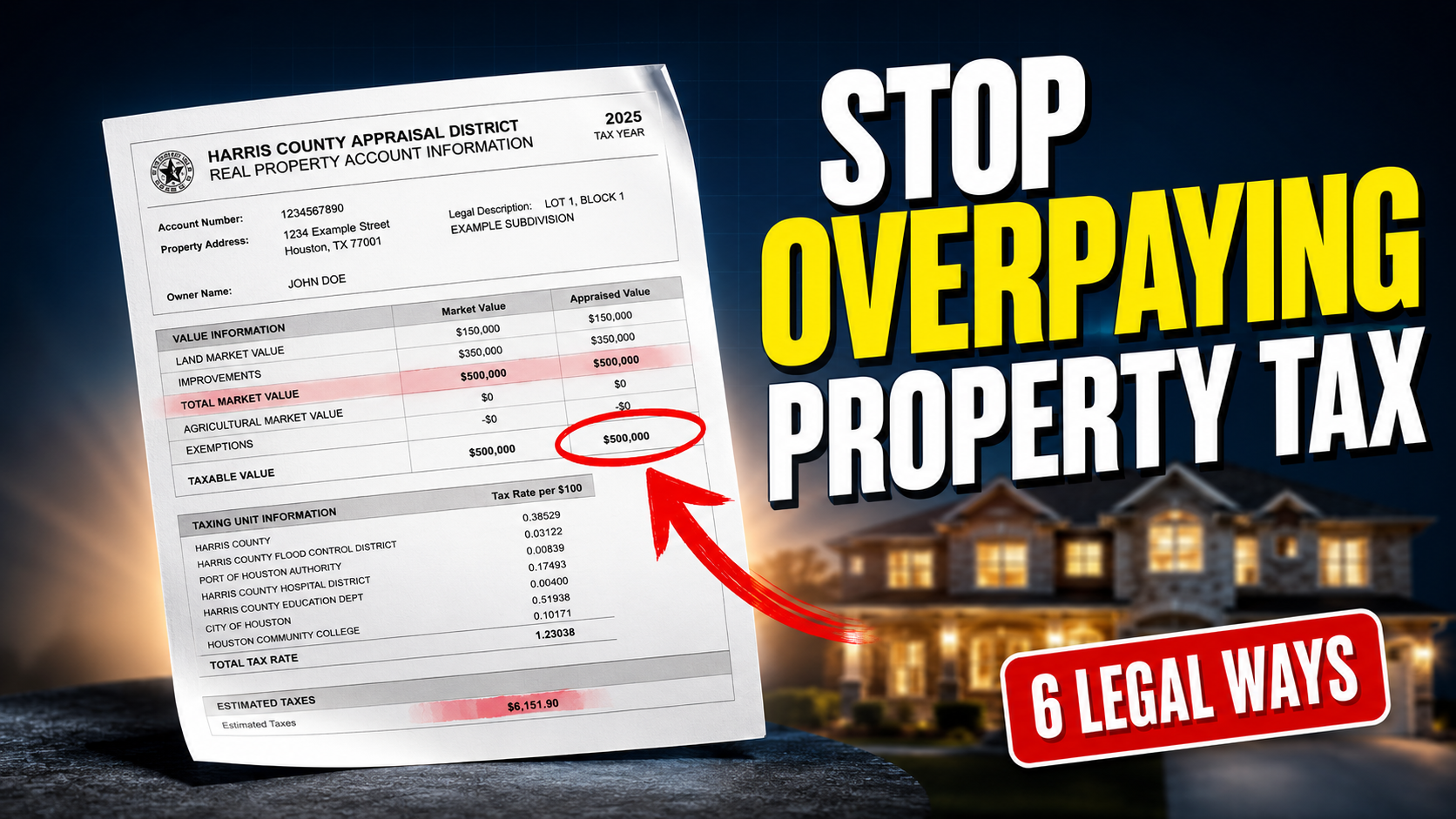
Every year, homeowners overpay because nobody told them what to check. If you want to lower property taxes on your home or your rental portfolio, the first thing to understand is simple. The county sends the bill, you pay it, and if something is wrong on the record, nobody is calling you to fix it.
I have seen owners lose hundreds or even thousands of dollars because an exemption was missing, a property detail was wrong, or an inflated assessment was never challenged. Most of those mistakes repeat quietly, year after year, until someone finally pulls the record behind the bill.
Below are six legal ways homeowners and real estate investors may be able to reduce, freeze, defer, or challenge what they owe. One of them takes less than 10 minutes to check. Another involves a deadline that can cost you an entire year of benefits. And strategy four surprises a lot of investors, because it has nothing to do with what the property is worth.
Important: property tax programs are local. Verify every benefit, qualification, and deadline with the assessor or property appraiser where the property is actually located.
Quick Answer: The 6 Ways to Lower Property Taxes
If you only read one section, read this one.
- Homestead exemption. Confirm it is active on your primary residence. It is not automatic everywhere.
- Special programs. Check exemptions and credits for seniors, veterans, disabled owners, and lower income households.
- Assessment appeal. Challenge a valuation that does not match the facts, with documentation.
- Property classification. Make sure the use on file matches the actual use of the property.
- Ownership structure. Understand how an LLC or trust transfer may affect exemptions and trigger reassessment.
- Record audit. Review every line of the property record after a purchase, renovation, inheritance, or use change.
The Fastest Way to Lower Property Taxes Starts With One Document
Most homeowners never look at the county property record. Instead, they look at the final bill, see the amount due, and pay it. However, the record behind that bill is exactly where a missing exemption, an incorrect classification, or a wrong property detail is hiding.
That is why two homes on the same street can have completely different tax bills. Exemptions, assessment history, ownership, classification, and local caps all differ from parcel to parcel.
Market Value, Assessed Value, and Taxable Value Are Not the Same Number
This trips people up constantly, so let us separate the three.
| Term | What it generally means |
|---|---|
| Market value | What the assessor believes the property would sell for |
| Assessed value | The value used in the local calculation, sometimes a percentage of market value |
| Taxable value | The value left after exemptions, which local tax rates are applied to |
Exemptions typically reduce the taxable value. Therefore, when an exemption goes missing, the rate has not changed at all. The base it is being applied to just got bigger.
Strategy 1: Confirm Your Homestead Exemption Is Actually Active
A homestead exemption generally applies to the property you use as your primary residence. Depending on state and local rules, it may reduce your taxable value, limit future increases in assessed value, or provide other protections.
But the exemption is not automatic everywhere. Some jurisdictions enroll eligible owners automatically. Others require an application. Some have strict filing deadlines, while others allow late filing or limited retroactive relief. In other words, you cannot assume the exemption is active simply because you live in the home.
Here Is Exactly What I Would Check
- Go to the county assessor or property appraiser website and pull the property record
- Confirm the property is classified as a primary residence
- Confirm the homestead exemption is listed
- Note the assessed value and the taxable value
- Look for any assessment cap or limitation tied to the property
Take Susan. She bought her home five years ago and assumed the county had automatically recognized it as her primary residence. She never checked. When she finally reviewed the record, the home was still listed as non-homestead, which meant she had missed the exemption for multiple years.
Whether Susan can recover prior year benefits depends entirely on local rules. Some jurisdictions allow limited corrections. Others do not. The lesson stands either way: do not wait five years to look. Pull the record this week.
Strategy 2: Check Programs for Seniors, Veterans, and Lower Income Owners
The easiest way to evaluate these programs is to ask two questions. Do you qualify because of who you are? And do you qualify because of your household income?
The first category may include age-based programs, disability exemptions, veteran benefits, or benefits for surviving spouses. The second may include income-based reductions, credits, circuit breaker programs, or deferrals.
Exemption, Freeze, Credit, or Deferral? The Difference Matters
These programs are not identical from one county to the next, and the mechanics vary widely.
| Program type | What it does |
|---|---|
| Exemption | Removes value from the taxable base |
| Assessment reduction | Lowers the assessed value used in the calculation |
| Freeze | Locks the assessment so future increases do not apply |
| Credit or rebate | Reduces or refunds a portion of the bill |
| Deferral | Postpones the tax rather than forgiving it |
That last one deserves real attention. A deferral can improve cash flow today, but the deferred amount may become due when the property is sold, transferred, or no longer qualifies. There may also be a lien on the property, and interest may accrue.
So when someone tells you that you can stop paying property taxes, ask better questions. Is the tax eliminated or postponed? Does the balance accrue interest? Does it affect refinancing? What happens when the owner dies or the property passes to heirs?
Consider Kurt. He is retired, owns his home outright, and his income is lower than it was during his working years. Meanwhile, the bill keeps climbing. Depending on local rules, Kurt may qualify for a senior exemption, an income-based program, an assessment freeze, or a deferral. Any of those could help. Even so, he needs to weigh the long-term result against his estate plan, his equity, and his family’s plans for the property.
Two more cautions. Veteran programs can be substantial, particularly for qualifying disabled veterans, although eligibility may depend on disability rating, ownership, occupancy, and state requirements. Also, income-based programs often define income differently than your federal return. Retirement income, Social Security, rental income, interest, and dividends may all count.
Finally, these are separate processes. Filing an appeal does not enroll you in a senior exemption. Applying for a homestead exemption does not challenge an inflated assessment. Apply for each one individually.
Strategy 3: Appeal an Assessment That Does Not Match Reality
Here is where you challenge the number itself. Importantly, you do not have to prove the county was wrong on purpose. You need to show that the assessment does not reflect the applicable facts or valuation rules.
Common Grounds for an Appeal
- The square footage on file is wrong
- The bedroom or bathroom count is incorrect
- The record shows a finished basement that is not finished
- The property is listed as renovated when it needs significant repairs
- The assessor relied on sales that are not truly comparable
- Similar nearby properties carry lower assessments without a reasonable explanation
An appeal is not a complaint about how much you would prefer to pay. Rather, it is an evidence-based argument. That means documentation: comparable sales, photos, inspection reports, repair estimates, and property records. A market analysis from a real estate professional may help too, although every jurisdiction sets its own rules about acceptable evidence.
The deadline is absolutely critical. In some areas you have a limited window after the assessment notice is mailed. In others, an informal review comes before a formal hearing. Miss it, and you may wait until the next assessment cycle.
Back to Susan. Her record shows a renovated kitchen, updated bathrooms, and a finished basement. In reality, the kitchen was damaged by a water leak, the bathrooms need work, and the basement is unfinished. She does not need to exaggerate anything. She simply needs to document the facts and submit them before the deadline.
Correcting even one false feature can reduce the value the county is taxing.
Where People Go Wrong
They search for a generic appeal form, submit it without supporting documentation, get denied, and then conclude that appeals do not work. An appeal is a process, not a magic form. Evidence quality matters, timing matters, and the argument has to connect to the valuation method used in that jurisdiction.
Strategy 4: Review How Your Property Is Classified
This is the one real estate investors need to slow down for.
A property may be classified as residential, commercial, agricultural, vacant land, multifamily, industrial, or another category under local law. That classification needs to match both the actual use and the legal requirements.
Certain agricultural, open space, conservation, or special use classifications may receive preferential treatment. However, you cannot claim a special classification because someone online called it a loophole. The property has to qualify, the activity has to be genuine, and the records have to support the claim.
You also need to understand what happens when the use changes. In some jurisdictions, a change triggers rollback taxes, which means the government may recalculate prior taxes for years when the property received a preferential assessment.
Kurt shows up again here. He owns a large parcel that historically qualified for agricultural classification, and now he wants to subdivide part of it for development. The portion still used for a qualifying purpose may be treated differently from the portion being developed. The timeline may matter. Prior benefits may be subject to recapture. All of that needs to be reviewed before the change, not after the new bill lands.
The same caution applies to any conversion. A rental becomes a primary residence. A primary residence becomes a rental. Vacant land becomes commercial. Each shift can affect the assessment and eligibility for prior exemptions.
Strategy 5: Understand How an LLC or Trust Transfer Affects Your Exemption
Plenty of investors hold property through an LLC, partnership, or trust for liability protection, financing, management, or estate planning. Those structures can make sense. Still, transferring a property can change its property tax treatment.
In some states, a homestead exemption may not be available when a primary residence is owned by an LLC. In other states, a qualifying trust may preserve the exemption if the occupant meets the requirements. A transfer may also trigger reassessment, transfer taxes, documentary taxes, or a review of existing exemptions. If there is a mortgage, the loan documents may create separate issues entirely.
So if someone tells you to move your home into an LLC because it is better for taxes, pause before signing anything. Ask these questions first:
- What happens to the homestead exemption after the transfer?
- Does the transfer trigger reassessment?
- Are transfer or documentary taxes owed?
- How will the lender treat it?
- Does the structure actually fit the goal?
An LLC is a tool. It is not automatically a tax strategy. The structure that suits an investment property may be completely inappropriate for a primary residence, and the structure that works in one state may create a problem in another.
Strategy 6: Audit the Property Record After Every Major Event
Strategy six is the habit that catches everything else early. After a purchase, renovation, subdivision, inheritance, ownership change, or conversion between personal and rental use, go line by line through the record.
Your Property Record Audit Checklist
- Ownership information and mailing address
- Property use and classification
- Land size and building size
- Bedroom and bathroom count
- Active exemptions
- Whether a prior owner’s exemption or classification carried forward incorrectly
That last item matters most after a purchase. Do not assume the prior owner’s classification transfers correctly. If you converted a primary residence into a rental, do not keep claiming a homestead exemption just because it was already on the property. Conversely, if you bought a rental that used to be someone’s home, confirm the record now reflects how you actually use it.
Inherited a property? Review the record before making changes, especially if it was receiving an exemption, an assessment cap, or a special use classification. Renovated? Check whether the county added improvements that were never completed, recorded the wrong square footage, or failed to update after a partial demolition. Subdivided? Verify parcels, land sizes, ownership, and classifications.
For commercial and multifamily property, the assessor may rely on income, expenses, vacancy, and capitalization rates. If those assumptions are wrong, the assessment may be wrong too. As a result, investors should review rent rolls, operating statements, leases, vacancy assumptions, and repair costs whenever the local process allows that evidence.
The Mistake I See Every Single Year
An owner gets a higher bill and assumes the county raised the tax rate. Sometimes that is true. Often, though, the increase comes from something else entirely: a classification change, a missing exemption, a reassessment after a transfer, a change in property use, or a plain error in the record.
The owner looks at the bill. I look at the record behind the bill. That record tells you where to investigate.
Property Taxes Are Only One Piece of Your Real Estate Tax Strategy
Reducing your assessment is worthwhile, but it is not the biggest lever available to most investors. You also need to understand depreciation, cost segregation, passive activity rules, repairs versus improvements, interest expense, and how rental activity connects to your overall income.
An investor might win an appeal and save several thousand dollars a year. That is genuinely helpful. Yet when that same investor buys or renovates a property, the larger opportunity often involves how costs are classified, when improvements are placed in service, and whether accelerated depreciation is available.
Some investors save more through one properly prepared cost segregation study than they will ever save appealing property taxes.
FAQs About How to Lower Property Taxes
Can I lower property taxes after I already paid the bill?
Sometimes. Certain jurisdictions allow limited corrections or retroactive relief for a missing exemption or a factual error in the record. Others do not. The available window varies by location, so check with your assessor as early as possible.
Do property tax appeals actually work?
They can, when they are supported by evidence and filed on time. Appeals fail most often because the owner submitted a generic form with no documentation, or missed the filing deadline entirely.
What is the difference between an exemption and a deferral?
An exemption removes value from the taxable base, which reduces what you owe. A deferral postpones payment instead. The deferred balance may come due on sale or transfer, may carry interest, and may create a lien on the property.
Does putting my house in an LLC lower property taxes?
Usually not, and in several states it can raise them. Moving a primary residence into an LLC may cost you the homestead exemption and may trigger reassessment or transfer taxes. Check your state and county rules before transferring anything.
How often should I check my property record?
At minimum once a year, before the assessment appeal deadline. Also check after any purchase, renovation, subdivision, inheritance, ownership change, or change in how the property is used.
Will my property taxes go up if I renovate?
They may, since improvements can increase assessed value. That said, errors happen often here. Counties sometimes record improvements that were never completed or log the wrong square footage, so always verify the record after work is done.
Your 10-Minute Plan to Lower Property Taxes This Week
Here is your homework. It really does take about 10 minutes.
- Download your current property record and the prior year record
- Compare assessed value, taxable value, exemptions, classification, ownership, and property characteristics
- Review the assessor website for available exemptions, reductions, freezes, deferrals, and appeal procedures
- Write down every relevant deadline
- Confirm whether the property is a primary residence, rental, commercial, agricultural, or a combination
- Check whether your current ownership structure affects eligibility
- Set a calendar reminder for the next assessment notice and filing deadline
Do not wait until the filing window closes to discover a missing exemption. Do not transfer a home into an LLC and learn afterward that the homestead treatment changed. Do not convert agricultural land without understanding rollback consequences. These are planning issues, and they have to be handled before the deadline or before the transaction.
Susan’s mistake was not buying the wrong house. It was never checking the record behind the bill.
Next up: cost segregation and how it can accelerate depreciation on qualifying real estate, where the biggest opportunities sit, and where investors need to be careful.