
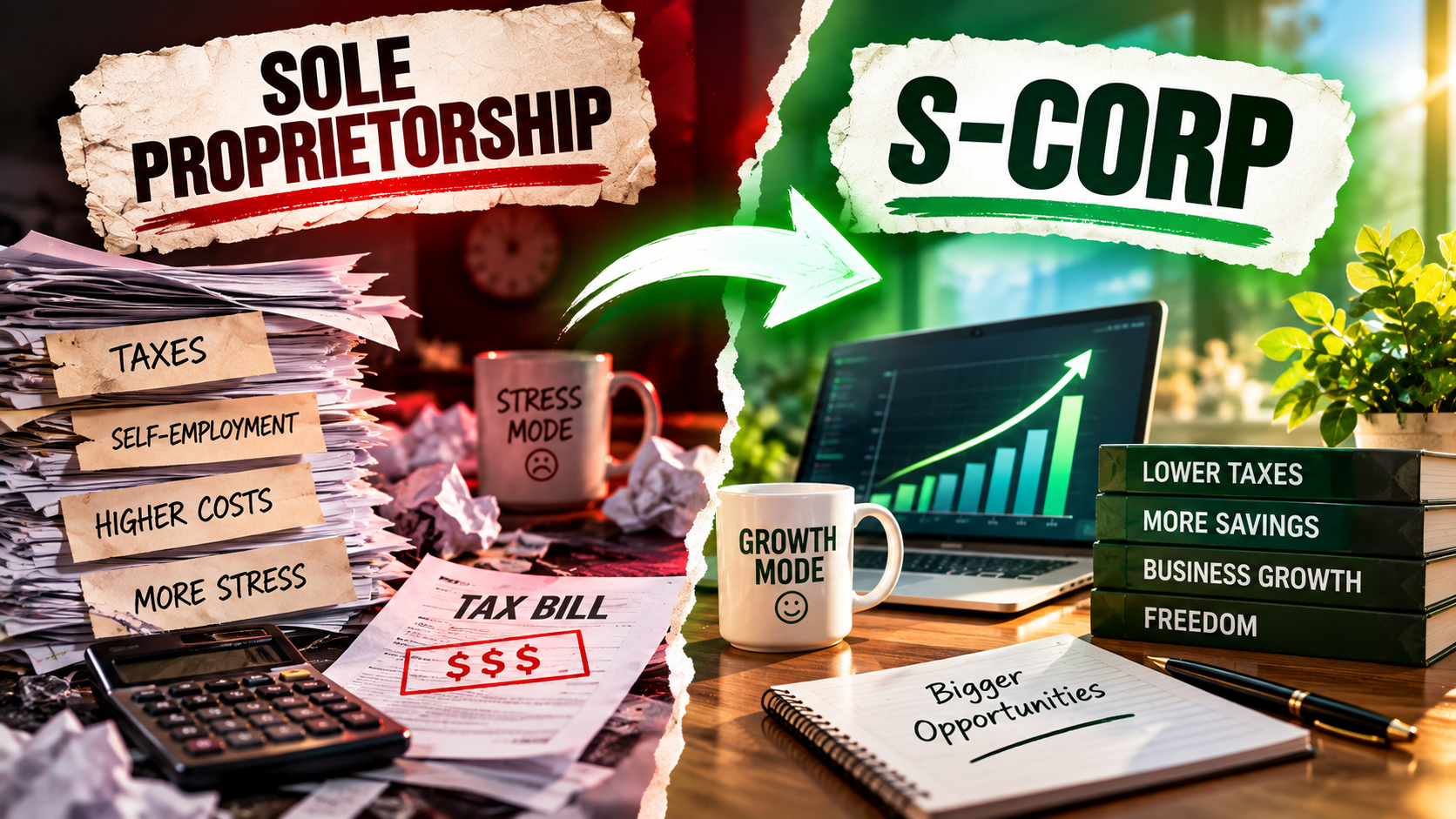
The article will begin with a relatable situation rather than immediately throwing tax terminology at the reader. Many successful business owners spend years concentrating on revenue, profitability, hiring, clients, and growth without taking a fresh look at how their business is taxed. A business can be extremely successful and still have a tax structure that deserves another look.
We’ll introduce the central question naturally: If your business is earning substantial profits, could an S-Corp election reduce the amount you’re paying in employment taxes? The answer isn’t automatically yes, and the article won’t present an S-Corp as a magic tax loophole. Instead, we’ll explain how the strategy works, when it can make sense, and why reasonable compensation is so important.
We’ll then introduce the real-world-style example from your source material. The business owner, referred to as Kris, operates a consulting firm generating approximately $1.5 million in annual profit. She had operated for years as a single-member LLC taxed as a sole proprietor. The example provides a useful way to understand what can happen when a profitable business owner compares the existing structure with an S-Corp structure.
What Is the Difference Between an S-Corp and a Sole Proprietorship?
This section will explain the difference in straightforward language before getting into complicated tax calculations. We’ll explain that a sole proprietor generally reports business income and expenses on Schedule C, with the resulting business profit flowing onto the owner’s personal tax return. That structure can be perfectly appropriate for many small businesses, particularly when the business is relatively simple or has modest profits.
The discussion will then move into self-employment tax. When you’re self-employed, you’re generally responsible for both the employee and employer sides of Social Security and Medicare taxes through the self-employment tax system. As business profits increase, that employment-tax burden can become an increasingly important part of the overall tax picture.
We’ll then introduce the S-Corp structure. An S-Corp doesn’t make your business income disappear, and it doesn’t mean you stop paying income tax. Instead, one of the major differences is how compensation and remaining business profit are treated for employment-tax purposes. That distinction is what makes an S-Corp worth modeling for some profitable business owners.
Why Self-Employment Tax Can Become a Bigger Issue as Your Business Grows
This section will explain self-employment tax in a way that a non-tax professional can actually understand. Rather than simply saying “15.3%,” we’ll explain what that number represents and why the calculation isn’t quite as simple as multiplying every dollar of business profit by 15.3%.
We’ll explain the Social Security portion, the Medicare portion, and the Additional Medicare Tax that can apply to higher-income taxpayers. We’ll also explain that the Social Security portion has a wage-base limitation, while Medicare taxes continue to apply beyond that point.
The purpose of this section is to help the reader understand why employment taxes can become significant even when the business owner already thinks they’re paying a large amount of federal income tax. The article will make a clear distinction between income tax and employment tax, because confusing the two is one of the easiest ways to misunderstand an S-Corp strategy.
A Real-World Example: A Consulting Business Earning $1.5 Million
Here we’ll slow down and walk through Kris’s example in detail.
Kris has operated her consulting company for approximately six years. The business has grown into a highly profitable operation with a team supporting the company, and the business is generating approximately $1.5 million in annual profit after business expenses. Despite that level of profitability, she has continued operating as a single-member LLC taxed as a sole proprietor.
We’ll explain what that means from a tax perspective. Her business profit flows through to her personal return, and the applicable self-employment tax calculation creates a substantial employment-tax obligation.
The source material calculates approximately $1.385 million of net earnings from self-employment after applying the 92.35% factor to the $1.5 million profit. It then walks through Social Security tax, Medicare tax, and Additional Medicare Tax, producing an estimated employment-tax burden of approximately $73,700 before considering income tax.
The article will make clear that this is a specific example, not a promise that every business earning $1.5 million will experience the exact same tax result.
How an S-Corp Can Change the Tax Picture
Now we’ll introduce the strategy.
The important concept is that an S-Corp owner who works in the business generally receives compensation through payroll. The remaining business profit can potentially be treated differently for employment-tax purposes, provided the structure is properly established and the owner is paid reasonable compensation.
We’ll explain this using the same numbers from the example. In the case study, a reasonable salary of approximately $150,000 was modeled. That salary becomes W-2 compensation and is subject to applicable payroll taxes. After salary, the employer’s share of payroll taxes, and other business expenses, the remaining profit can generally pass through to the owner without being subject to self-employment tax.
We’ll also explain an important distinction that many online articles get wrong: S-Corp distributions are not simply “tax-free income.” The business still has taxable income, and distributions don’t eliminate the owner’s income-tax liability.
The $50,000 Difference: Understanding the Tax Savings Example
This will be one of the most detailed sections of the article because it contains the central numerical example.
Under the sole-proprietorship scenario presented in the source material, Kris’s employment and Additional Medicare taxes were approximately $73,700. Under the modeled S-Corp scenario, the combined employee and employer portions of Social Security and Medicare taxes on the $150,000 salary were approximately $22,950.
That creates a gross employment-tax difference of roughly $50,750.
However, the article will not simply declare that Kris “saved $50,750 in taxes.” We’ll explain why that would be misleading. The actual financial benefit needs to account for the employer portion of payroll taxes, the self-employment-tax deduction that would have existed under the sole-proprietor structure, potential QBI effects, state taxes, payroll expenses, accounting costs, tax-return preparation costs, and other circumstances.
This nuance is important because the goal is to teach the reader how to think about an S-Corp decision rather than sell them on a headline number. The source material itself emphasizes that the $50,000-plus figure is a gross employment-tax difference and that the true bottom line requires a full tax projection.
The Most Important S-Corp Rule: You Must Pay Yourself a Reasonable Salary
This section will transition from the attractive part of the strategy to the rule that makes the strategy defensible.
We’ll explain that an S-Corp owner who provides services to the company generally cannot simply decide to pay themselves an artificially low salary and take everything else as distributions. The IRS requires reasonable compensation for shareholder-employees who perform services for the corporation.
We’ll explain reasonable compensation conversationally: What would it cost to hire someone else to perform the work you’re doing? That question doesn’t produce an automatic answer, but it gives the business owner a starting point.
How Do You Determine a Reasonable S-Corp Salary?
Rather than presenting a single formula, we’ll explain the factors that can influence the analysis.
These can include the owner’s responsibilities, experience, education and training, time spent working in the business, comparable compensation for similar roles, the company’s financial circumstances, and the extent to which the company’s revenue depends directly on the owner’s personal services.
We’ll spend additional time on consulting businesses because they’re particularly interesting. If virtually all of the company’s revenue is generated because of the owner’s personal expertise, relationships, reputation, and services, it can be difficult to justify an extremely low salary.
On the other hand, if the company has a substantial team and employees are performing significant revenue-generating work, the reasonable-compensation analysis may look different.
The article will emphasize that there isn’t a universal salary percentage or magic number that works for every S-Corp.
Why Paying Yourself an Artificially Low Salary Can Backfire
This section will directly address one of the most common S-Corp misconceptions.
We’ll discuss the temptation to pay yourself a very small W-2 salary and classify the majority of the business’s remaining cash as distributions. We’ll explain why that isn’t a defensible strategy when the salary doesn’t reasonably reflect the work the owner actually performs.
We’ll also explain the potential consequences of getting compensation wrong, including the possibility of the IRS reclassifying amounts as wages and the resulting payroll taxes, penalties, and interest.
This section will be written in a conversational tone because it’s answering the question many business owners are really asking: “Can I just pay myself less?”
Does an S-Corp Eliminate Income Tax?
This section will answer one of the most important questions directly:
No, an S-Corp does not eliminate your income tax.
We’ll explain that S-Corp income generally passes through to the owner’s personal return. The potential advantage we’re discussing is primarily related to employment-tax treatment—not making the underlying business profit disappear.
This distinction will also help prevent readers from confusing “tax savings” with “no taxes.”
What About the Qualified Business Income Deduction?
We’ll then discuss the Qualified Business Income deduction and why it needs to be considered when modeling an S-Corp election.
The article will explain that wages paid by an S-Corp and remaining business profit are treated differently for QBI purposes. We’ll also discuss the additional complications that can arise for higher-income business owners and specified service businesses, including consulting businesses.
Rather than promising readers a specific QBI deduction, we’ll explain why this is another reason a complete tax projection is more useful than a simple online S-Corp calculator.
The Hidden Costs of an S-Corp
This section will provide balance.
An S-Corp isn’t free to operate. Once a business makes the election, there can be additional administrative requirements, including running payroll, handling payroll tax filings, preparing W-2s, maintaining appropriate accounting records, and filing the corporation’s tax return.
We’ll also discuss potential state-level fees, franchise taxes, or other requirements because these can vary depending on where the business operates.
The key point will be simple: The bigger the potential tax savings, the easier it may be to justify the additional administration. But when the potential savings are small, the additional costs can change the equation.
When Does an S-Corp Actually Make Sense?
Instead of giving the reader an arbitrary “S-Corp if you make more than $X” rule, we’ll explain why there is no universal cutoff that works for everyone.
We’ll walk through the questions a business owner should consider: How profitable is the company? How much would reasonable compensation be? How much employment tax might change? What will payroll cost? What will the additional tax preparation cost? What are the state implications? Could QBI change the result?
The reader should come away understanding that the correct answer comes from modeling the numbers, not from copying another business owner’s structure.
When an S-Corp May Not Be Worth the Extra Complexity
This section is important because it prevents the article from becoming one-sided.
We’ll explain that an S-Corp may not be attractive when the business has relatively low or inconsistent profits, when the potential employment-tax savings are small, or when additional payroll, accounting, tax-preparation, and state costs consume most of the potential benefit.
We’ll reinforce that an S-Corp is a business-tax strategy—not a badge of success that every entrepreneur needs.
When Should You Make an S-Corp Election?
We’ll explain the timing requirements in plain English.
For a calendar-year business, the standard federal election deadline generally falls two months and 15 days after the beginning of the tax year the election is intended to cover. We’ll explain why that commonly works out to March 15 for calendar-year businesses, while also explaining why business formation dates and tax years can make individual situations different.
We’ll also briefly discuss late-election relief and why business owners shouldn’t build their strategy around missing the normal deadline and hoping for relief later.
What Is Form 2553 and Why Does It Matter?
This section will explain Form 2553 without turning the article into an IRS instruction manual.
We’ll explain that making an S-Corp election involves more than simply telling your accountant that you want to be an S-Corp. The appropriate election needs to be made, and once the election is in place, the business needs to operate consistently with the requirements that come with S-Corp taxation.
We’ll then connect the election back to the broader strategy: Form 2553 is the beginning of the process, not the entire strategy.
S-Corp vs. Sole Proprietorship: A Side-by-Side Comparison
We’ll include a readable comparison explaining the major differences between the two structures.
The discussion will cover:
- Tax reporting: How the business is generally reported under each structure.
- Owner compensation: How compensation works for an S-Corp owner compared with a sole proprietor.
- Employment taxes: Why the treatment can differ.
- Payroll: Why an S-Corp owner generally needs to deal with payroll.
- Distributions: How S-Corp distributions differ from a sole proprietor simply taking money out of the business.
- Compliance: Why an S-Corp typically requires additional administrative work.
- Potential tax savings: Why the benefit depends on the business’s actual numbers.
How to Decide Whether an S-Corp Is Right for Your Business
This will become the practical decision-making section.
We’ll guide the reader through looking at their most recent tax return, identifying their Schedule C profit, reviewing their self-employment tax, estimating reasonable compensation, and comparing the current structure against an S-Corp structure.
The article will encourage readers to look at the after-cost, after-tax result, rather than simply focusing on the biggest possible employment-tax difference.
What Business Owners Should Do Before Making the Switch
We’ll give readers a straightforward process they can follow.
First, gather the latest tax return. Then identify business profit and the current employment-tax burden. Next, estimate a defensible reasonable salary. After that, model the S-Corp structure, including payroll taxes and administrative costs. Finally, review the complete projection with a qualified tax professional before making the election.
This gives the article a strong practical conclusion rather than simply ending with “talk to your accountant.”